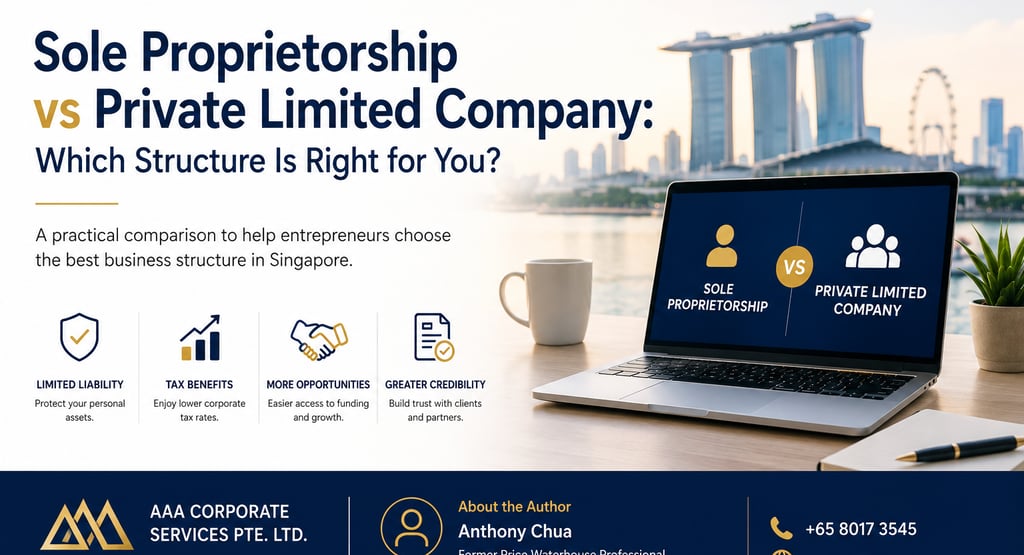
Sole Proprietorship vs Private Limited Company: Which Structure is Right for You?
6/18/20265 min read
Understanding Sole Proprietorship
A sole proprietorship is a business structure owned and operated by a single individual. This straightforward structure is characterized by its simplicity, as the owner has complete control and decision-making authority over the business. There are minimal formalities required to establish a sole proprietorship, making it an attractive option for many entrepreneurs who seek to start small ventures without the complexities associated with other business entities.
From a legal standpoint, a sole proprietorship is not considered a separate legal entity. This means that the owner bears unlimited personal liability for business debts and obligations. In other words, if the business incurs debt or faces legal claims, the owner's personal assets may be at risk. This characteristic is a significant consideration for individuals contemplating forming a sole proprietorship, as it underscores the importance of assessing personal and financial risk.
Tax obligations for sole proprietors are also relatively simple. The income generated by the business is reported on the owner's personal tax return, thus avoiding the double taxation often faced by corporations. Sole proprietors usually pay self-employment taxes, which cover Social Security and Medicare. This direct link between personal and business income can be both advantageous and disadvantageous, depending on the individual’s financial situation.
Common examples of businesses that typically operate as sole proprietorships include freelancers, tutors, and small retail shops. Freelancers, such as graphic designers and writers, often choose this structure due to its flexibility and ease of management. Likewise, tutors provide educational services and maintain personal control over their branding and pricing. Small retail shops frequently embody the sole proprietor model as well, enabling owners to operate with minimal bureaucratic hurdles.
In summary, while a sole proprietorship offers a straightforward path to entrepreneurship, it is vital for business owners to understand the legal implications, tax responsibilities, and liability issues involved.
Understanding a Private Limited Company
A private limited company, often denoted as Pte. Ltd., is recognized as a distinct legal entity, separate from its shareholders and directors. This independence means that the company can own assets, incur liabilities, and engage in legal contracts in its own name, rather than that of its owners. This structure is particularly attractive to entrepreneurs and business owners as it provides several advantages regarding liability and operational flexibility.
One of the key features of a private limited company is its limited liability status. Shareholders are accountable only for the company’s debts up to the amount they invested in shares, safeguarding personal assets from business creditors. This is a significant benefit, especially in industries with inherent financial risks. Consequently, the private limited company structure is commonly favored by startups, technology firms, and businesses looking to limit their financial exposure while attracting investments.
In terms of ownership, private limited companies can have multiple shareholders, but the transfer of shares is typically restricted, ensuring that control remains within a small group of individuals. This characteristic ensures a stable management structure and aligns with the interests of the original founders. Additionally, private limited companies are well-suited for businesses aiming to raise capital without the complexities that often accompany public offerings.
Further, because a private limited company can retain profits to reinvest in the business, it is commonly preferred by entrepreneurs who wish to grow their operations over time. This capacity for longevity and growth, coupled with the benefits of limited liability and various fundraising options, makes the private limited company an appealing choice for many entrepreneurs embarking on their business journey.
Key Differences Between Sole Proprietorship and Private Limited Company
A sole proprietorship and a private limited company are two distinct business structures that offer unique legal and operational frameworks. One of the primary differences lies in the legal status of the business. A sole proprietorship is not recognized as a separate legal entity. Instead, it is tied directly to the owner, meaning the owner bears full responsibility for all aspects of the business. In contrast, a private limited company is considered a separate legal entity, which can own assets, enter contracts, and incur liabilities independently of its owners (shareholders).
The implications of this distinction extend significantly to liability. In a sole proprietorship, the owner has unlimited liability, which means personal assets may be at risk if the business faces financial difficulties or legal challenges. Conversely, shareholders in a private limited company enjoy limited liability protection, which safeguards their personal assets beyond their investment in the company. This limitation can provide greater security and peace of mind for business owners, especially in high-risk industries.
Tax treatment also varies significantly between these two structures. A sole proprietor reports business income on their personal tax return, with profits taxed as personal income. This tax approach can sometimes lead to higher tax liabilities as income increases. Alternatively, a private limited company is taxed as a separate legal entity, often at a lower corporate tax rate. This separate taxation can enable better tax planning strategies for shareholders, contributing to long-term financial benefits.
Understanding these key differences—legal identity, liability exposure, and tax treatment—is crucial for entrepreneurs evaluating which business structure suits their needs best. By weighing the risks and protections inherent in each option, prospective business owners can make informed decisions that align with their business objectives.
Making the Choice: Which Structure is Right for You?
When entrepreneurs embark on the journey of establishing their business, one crucial decision they face is the selection of the appropriate business structure. The choice between a sole proprietorship and a private limited company can significantly influence various aspects of the business, including management flexibility, liability, and taxation. To guide you in making this decision, consider several key factors.
First, evaluate the size and scale of your business operations. Sole proprietorships are typically suited for small businesses or freelancers, allowing for simpler management and direct control. Conversely, private limited companies are often chosen for larger ventures, especially where scalability and external investment are anticipated. This structure can attract investors while providing limited liability protection.
Risk tolerance is another critical factor. Business owners comfortable with personal liability may favor a sole proprietorship. In this case, personal assets may be at risk should the business incur debts or face legal issues. However, if limiting personal liability is a priority, forming a private limited company might be the prudent option, safeguarding personal assets against business risks.
The growth potential of your enterprise also plays a vital role. If you foresee significant expansion, a private limited company offers the advantage of easier access to capital and the ability to issue shares, which is essential for attracting investors. In contrast, a sole proprietorship may face limitations in funding and resource acquisition as growth progresses.
Finally, consider tax implications. Sole proprietorships benefit from straightforward tax filings, where business income is taxed as personal income. However, private limited companies may enjoy more favorable tax rates and opportunities for profit retention.
In conclusion, choosing between a sole proprietorship and a private limited company depends on your unique business goals, financial considerations, and risk tolerance. Each structure serves different needs, and by comprehensively evaluating these factors, you can make an informed choice that aligns with your entrepreneurial aspirations.